



Agri Retail Demands Professional Management Skills
» and an effective pipeline of professional retail management capability «
By Peritum Agri Institute
Agricultural retail used to be a protected, producer-orientated business. Customers came to the branch because there was little alternative, and a well-stocked shelf and sound administration were usually enough. That world has changed dramatically in the past decade. Agricultural companies now face competitive pressure on every side: they must protect and grow their markets, offer technology-driven solutions and develop new market segments.
And yet, Agri Retail still happens in a rural, relationship-driven environment where values and personal touch are non-negotiable. The branches that thrive are the ones that combine sharp business thinking with genuine care for the customer across the counter.
From administrator to entrepreneur
Branch managers have traditionally been appointed for their excellent administrative ability and developed through the ranks. Those strengths still matter, but the role now asks for more. Today’s branch manager must think like an entrepreneur: someone with a competitive mindset who understands cash flow, manages stock as an investment, leads an engaged team and builds lasting relationships with customers.
That shift does not happen by accident. If we expect managers to run the branch as a business, we have to equip them to do so.
Talent development offers a competitive advantage
Retail management calls for a balance of four very different skills that are rarely found together in one natural competency profile: the ability to combine operational oversight with close attention to detail; an analytical and evaluative approach to managing budgets and stock; a creative, aesthetic eye for branch layout and product presentation; and an exceptional ability to build trust with people and mobilise them to follow your lead sustainably, both internally and externally.
The Peritum Agri Retail Management Development Programme is designed to sharpen skills at a very practical level and to equip learners with processes to bridge the gaps in their natural competency categories. Our approach is a structured five-phase process that builds insight and then converts it into action.
First, through examples and questions, we create space for spontaneous buy-in to the ‘why this matters’. Second, we guide the learner to examine the elements practically and to see the connections. Third, we provide a process for analysing the elements and identifying shortcomings, in the contect of the branch. Fourth, a measurable outcome or set out outcomes is formulated for each core element. Finally, the learner puts a practical action plan in place to achieve them.
This approach to learning develops insight, skills, and an applicable process and focal point for implementation in the branch.
Not about a certificate, but about the branch
The programme is non-accredited and carries no credits. That is deliberate. It is a custom-made solution aligned to your company’s Agri Retail service strategy, and its purpose is immediate, measurable value in the business. Management competence is generic, but its application differs from company to company, so the practical side of the programme is designed around your culture, approach and aspirations.
It runs over 10 to 12 months at a pace of one module every four to six weeks. This leaves room to apply new skills at the branch between sessions and limits disruption in the workplace. Sessions are presented as contact classes or live Teams sessions, in Afrikaans or English, and learners are supported by videos, case studies and resources on the STRIDE online platform. A short online assessment follows each module.
Six modules, one purpose
The six modules follow the way a branch actually runs:
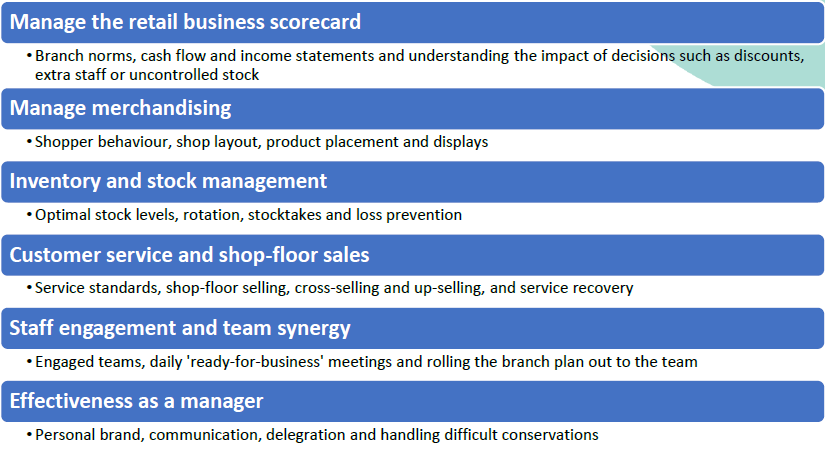
The heart of the programme: coaching towards a branch business plan
What sets this programme apart is what learners produce. Every learner builds a complete business plan for their own branch, guided by a Peritum business coach. The coach works alongside the learner throughout the programme, so the content is never left as theory in a classroom. Each module includes an activity, facilitated by the lecturer, that brings the concepts into the plan, and the coach helps the learner turn those concepts into decisions that fit their own branch.
The plan grows step by step as the modules progress. By the end it contains:
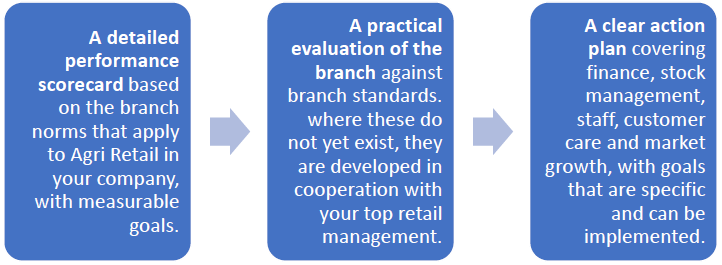
This is where the coaching earns its keep. A coach asks the practical questions: What does your scorecard say about this branch? Where is cash tied up in slow-moving stock? How will you cascade the plan to your team on Monday morning? Together they shape the answers into a plan the manager owns, rather than a generic document filed away after the course.
At the end of the programme, each learner presents an executive overview of their branch business case to top retail management. This closes the loop. Management sees real plans for real branches, learners gain confidence and accountability, and the company gets a clear view of where the opportunities lie.
Immediate value, long-term strength
Because the plan is built on the learner’s own branch, the value starts while the programme is still running. Better stock decisions, a more purposeful team and a stronger customer experience begin to show up in the branch itself, and the scorecard makes the progress measurable.
In a competitive retail environment, the managers who run your branches are your most important asset. Giving them the tools and the coaching to run those branches as businesses is an investment that pays back at the till.
Interested?
Contact Peritum Agri Institute to discuss a programme customised for your company: development2@peritumagri.com or 051 451 1120 | www.peritumagri.com


